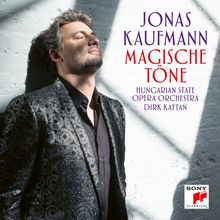
Jonas Kaufmann - Magische Tone
The new album "Magische Töne" by Jonas Kaufmann contains some of the most beautiful operetta and opera melodies. In addition to evergreens by Emmerich Kálmán, Franz Lehár and Paul Abraham, it also contains one of the most popular arias in the tenor repertoire: the eponymous Magic Tones from the opera The Queen of Sheba by Karl Goldmark. After Vienna, now Budapest: Jonas Kaufmann recorded his new album there with the orchestra of the Hungarian State Opera, conducted by Dirk Kaftan. The focus is on highlights by composers from the era of the Austro-Hungarian Dual Monarchy (1867–1918), above all evergreens from the operettas by Emmerich (Imre) Kálmán, Franz (Ferenc) Lehár and Paul (Pál) Abraham. "It is an incredible musical richness that this epoch has produced," Kaufmann sums up. "Looking back, we can be happy that most of these works were premiered in Vienna and written in German, which quickly made them internationally known and popular." In the Hungarian language, they would probably have remained a national art form – like the operettas of Jenő Huszka (1875–1960), which, despite their qualities, were hardly performed outside Hungary. For the present album, Kaufmann chose one of Huszka's best-known titles: the entrance song of Bob from the operetta Bob herceg. "There, the whole world is still red-white-green" – is the last word in the duet Come with me to Varasdin from Countess Mariza of Kálmán. Of course, the colours of the Hungarian tricolour can be heard just as clearly in the music as in the lyrics and thus also represent a piece of national identity. But this second heyday of operetta also stands for that melancholy memory of a liberal, cosmopolitan, culturally diverse Europe that perished with the First World War and which Stefan Zweig described so vividly in his memoirs The World of Yesterday. Jonas Kaufmann's duet partner is Nikola Hillebrand, who has recently become one of the most sought-after sopranos of her generation. For Dirk Kaftan, the conductor of the album, the recordings were a welcome reencounter with a genre that he studied thoroughly during his time as General Music Director in Graz. "Above all, you have to empathize with a musical language that cannot be fixed in writing. Gustav Mahler's famous sentence applies to this repertoire in particular: 'The most important thing is not in the notes!' That's one of the reasons why I found the recording sessions with the Orchestra of the Hungarian State Opera exhilarating: the musicians know exactly what it's about and how to make it sound." In the innovative style of Paul Ábrahám, who enriched the operetta genre with elements of jazz, foxtrot and revue, Kaftan sees a clear parallel to the works of Kurt Weill, as a "means of expression of a future that was destroyed by the National Socialists". Two opera titles round off the new album: the aria Hazám, hazám ("My Homeland") from the opera Bánk bán by Ferenc Erkel – a passionate commitment to the Hungarian homeland – and "Magic Tones", the famous aria from Karl (Károly) Goldmark's The Queen of Sheba. These sounds become magical when the singer knows how to extract the delicate, intimate piano sounds from his voice in an exposed position – which is particularly appealing to Jonas Kaufmann: "Someone once told me: Your loud tones are rousing, but your quiet ones drive me crazy. Dramatic tones probably have more of an effect on the listener's body and nervous system, the quiet ones on the heart and soul."
The new album "Magische Töne" by Jonas Kaufmann contains some of the most beautiful operetta and opera melodies. In addition to evergreens by Emmerich Kálmán, Franz Lehár and Paul Abraham, it also contains one of the most popular arias in the tenor repertoire: the eponymous Magic Tones from the opera The Queen of Sheba by Karl Goldmark. After Vienna, now Budapest: Jonas Kaufmann recorded his new album there with the orchestra of the Hungarian State Opera, conducted by Dirk Kaftan. The focus is on highlights by composers from the era of the Austro-Hungarian Dual Monarchy (1867–1918), above all evergreens from the operettas by Emmerich (Imre) Kálmán, Franz (Ferenc) Lehár and Paul (Pál) Abraham. "It is an incredible musical richness that this epoch has produced," Kaufmann sums up. "Looking back, we can be happy that most of these works were premiered in Vienna and written in German, which quickly made them internationally known and popular." In the Hungarian language, they would probably have remained a national art form – like the operettas of Jenő Huszka (1875–1960), which, despite their qualities, were hardly performed outside Hungary. For the present album, Kaufmann chose one of Huszka's best-known titles: the entrance song of Bob from the operetta Bob herceg. "There, the whole world is still red-white-green" – is the last word in the duet Come with me to Varasdin from Countess Mariza of Kálmán. Of course, the colours of the Hungarian tricolour can be heard just as clearly in the music as in the lyrics and thus also represent a piece of national identity. But this second heyday of operetta also stands for that melancholy memory of a liberal, cosmopolitan, culturally diverse Europe that perished with the First World War and which Stefan Zweig described so vividly in his memoirs The World of Yesterday. Jonas Kaufmann's duet partner is Nikola Hillebrand, who has recently become one of the most sought-after sopranos of her generation. For Dirk Kaftan, the conductor of the album, the recordings were a welcome reencounter with a genre that he studied thoroughly during his time as General Music Director in Graz. "Above all, you have to empathize with a musical language that cannot be fixed in writing. Gustav Mahler's famous sentence applies to this repertoire in particular: 'The most important thing is not in the notes!' That's one of the reasons why I found the recording sessions with the Orchestra of the Hungarian State Opera exhilarating: the musicians know exactly what it's about and how to make it sound." In the innovative style of Paul Ábrahám, who enriched the operetta genre with elements of jazz, foxtrot and revue, Kaftan sees a clear parallel to the works of Kurt Weill, as a "means of expression of a future that was destroyed by the National Socialists". Two opera titles round off the new album: the aria Hazám, hazám ("My Homeland") from the opera Bánk bán by Ferenc Erkel – a passionate commitment to the Hungarian homeland – and "Magic Tones", the famous aria from Karl (Károly) Goldmark's The Queen of Sheba. These sounds become magical when the singer knows how to extract the delicate, intimate piano sounds from his voice in an exposed position – which is particularly appealing to Jonas Kaufmann: "Someone once told me: Your loud tones are rousing, but your quiet ones drive me crazy. Dramatic tones probably have more of an effect on the listener's body and nervous system, the quiet ones on the heart and soul."
Description
The new album "Magische Töne" by Jonas Kaufmann contains some of the most beautiful operetta and opera melodies. In addition to evergreens by Emmerich Kálmán, Franz Lehár and Paul Abraham, it also contains one of the most popular arias in the tenor repertoire: the eponymous Magic Tones from the opera The Queen of Sheba by Karl Goldmark. After Vienna, now Budapest: Jonas Kaufmann recorded his new album there with the orchestra of the Hungarian State Opera, conducted by Dirk Kaftan. The focus is on highlights by composers from the era of the Austro-Hungarian Dual Monarchy (1867–1918), above all evergreens from the operettas by Emmerich (Imre) Kálmán, Franz (Ferenc) Lehár and Paul (Pál) Abraham. "It is an incredible musical richness that this epoch has produced," Kaufmann sums up. "Looking back, we can be happy that most of these works were premiered in Vienna and written in German, which quickly made them internationally known and popular." In the Hungarian language, they would probably have remained a national art form – like the operettas of Jenő Huszka (1875–1960), which, despite their qualities, were hardly performed outside Hungary. For the present album, Kaufmann chose one of Huszka's best-known titles: the entrance song of Bob from the operetta Bob herceg. "There, the whole world is still red-white-green" – is the last word in the duet Come with me to Varasdin from Countess Mariza of Kálmán. Of course, the colours of the Hungarian tricolour can be heard just as clearly in the music as in the lyrics and thus also represent a piece of national identity. But this second heyday of operetta also stands for that melancholy memory of a liberal, cosmopolitan, culturally diverse Europe that perished with the First World War and which Stefan Zweig described so vividly in his memoirs The World of Yesterday. Jonas Kaufmann's duet partner is Nikola Hillebrand, who has recently become one of the most sought-after sopranos of her generation. For Dirk Kaftan, the conductor of the album, the recordings were a welcome reencounter with a genre that he studied thoroughly during his time as General Music Director in Graz. "Above all, you have to empathize with a musical language that cannot be fixed in writing. Gustav Mahler's famous sentence applies to this repertoire in particular: 'The most important thing is not in the notes!' That's one of the reasons why I found the recording sessions with the Orchestra of the Hungarian State Opera exhilarating: the musicians know exactly what it's about and how to make it sound." In the innovative style of Paul Ábrahám, who enriched the operetta genre with elements of jazz, foxtrot and revue, Kaftan sees a clear parallel to the works of Kurt Weill, as a "means of expression of a future that was destroyed by the National Socialists". Two opera titles round off the new album: the aria Hazám, hazám ("My Homeland") from the opera Bánk bán by Ferenc Erkel – a passionate commitment to the Hungarian homeland – and "Magic Tones", the famous aria from Karl (Károly) Goldmark's The Queen of Sheba. These sounds become magical when the singer knows how to extract the delicate, intimate piano sounds from his voice in an exposed position – which is particularly appealing to Jonas Kaufmann: "Someone once told me: Your loud tones are rousing, but your quiet ones drive me crazy. Dramatic tones probably have more of an effect on the listener's body and nervous system, the quiet ones on the heart and soul."