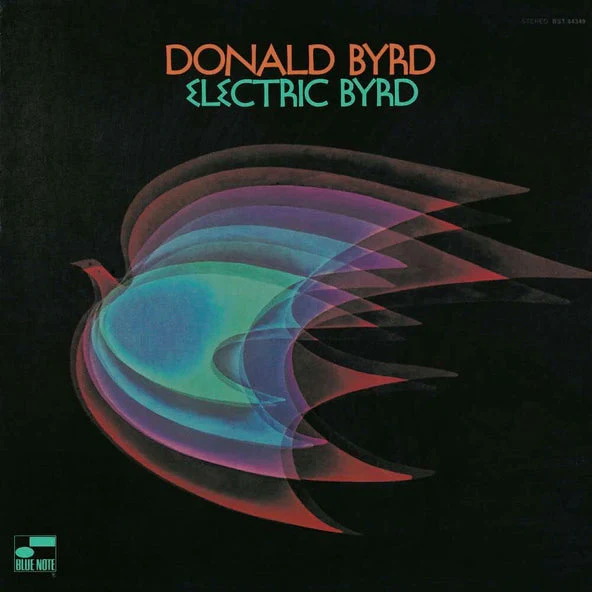
Donald Byrd - Electric Byrd
Donald Byrd's transitional sessions from 1969-1971 are among the trumpeter's most fascinating works.
They manage the balancing act between accessible, funky fusion in the style of Davis and legitimate jazz improvisation.
Electric Byrd from 1970 is the best of these recordings, as Byrd embraces the innovations of Bitches Brew and develops one of his most consistent fusion sets of any stripe.
Byrd leads his largest fusion group to date (ten to 11 pieces), featuring many of his collaborators of the time (including Jerry Dodgion, Lew Tabackin and Frank Foster on various woodwind instruments).
Most notable are electric pianist Duke Pearson, who once again dominates the arrangements, and drummer Airto Moreira, who in places provides a strong Brazilian feel that precedes Return to Forever.
Moreira also contributes one of the four compositions, "Xibaba", which begins as a breezy Brazilian melody but then morphs into a free-form effects extravaganza; the remaining tracks are Byrd originals that prove equally inventive and diverse.
The Brazilian-tinged opener "Estavanico" has a gentle, driving quality that is often interrupted by shrill dissonances.
There's also the shifting - and sometimes disappearing - slow groove of 'Essence' and the hard-edged, bop-based funk of 'The Dude'.Much of the album has a spacey, floating feel indebted to Bitches Brew's psychedelic fusion; it's full of open-ended solo improvisations, lots of amplification effects and striking sonic textures.The arrangements are always surprising, and the band never works with the same groove for too long, changing or dropping the underlying rhythms altogether.Even though Electric Byrd wears its influences on its sleeve, this is undeniably a sophisticated, high-quality fusion sound.
As far as Donald Byrd is concerned, it is also the end of the line for jazz purists, which is perhaps one of the reasons why the album has not yet received the attention it deserves.
Donald Byrd's transitional sessions from 1969-1971 are among the trumpeter's most fascinating works.
They manage the balancing act between accessible, funky fusion in the style of Davis and legitimate jazz improvisation.
Electric Byrd from 1970 is the best of these recordings, as Byrd embraces the innovations of Bitches Brew and develops one of his most consistent fusion sets of any stripe.
Byrd leads his largest fusion group to date (ten to 11 pieces), featuring many of his collaborators of the time (including Jerry Dodgion, Lew Tabackin and Frank Foster on various woodwind instruments).
Most notable are electric pianist Duke Pearson, who once again dominates the arrangements, and drummer Airto Moreira, who in places provides a strong Brazilian feel that precedes Return to Forever.
Moreira also contributes one of the four compositions, "Xibaba", which begins as a breezy Brazilian melody but then morphs into a free-form effects extravaganza; the remaining tracks are Byrd originals that prove equally inventive and diverse.
The Brazilian-tinged opener "Estavanico" has a gentle, driving quality that is often interrupted by shrill dissonances.
There's also the shifting - and sometimes disappearing - slow groove of 'Essence' and the hard-edged, bop-based funk of 'The Dude'.Much of the album has a spacey, floating feel indebted to Bitches Brew's psychedelic fusion; it's full of open-ended solo improvisations, lots of amplification effects and striking sonic textures.The arrangements are always surprising, and the band never works with the same groove for too long, changing or dropping the underlying rhythms altogether.Even though Electric Byrd wears its influences on its sleeve, this is undeniably a sophisticated, high-quality fusion sound.
As far as Donald Byrd is concerned, it is also the end of the line for jazz purists, which is perhaps one of the reasons why the album has not yet received the attention it deserves.
Description
Donald Byrd's transitional sessions from 1969-1971 are among the trumpeter's most fascinating works.
They manage the balancing act between accessible, funky fusion in the style of Davis and legitimate jazz improvisation.
Electric Byrd from 1970 is the best of these recordings, as Byrd embraces the innovations of Bitches Brew and develops one of his most consistent fusion sets of any stripe.
Byrd leads his largest fusion group to date (ten to 11 pieces), featuring many of his collaborators of the time (including Jerry Dodgion, Lew Tabackin and Frank Foster on various woodwind instruments).
Most notable are electric pianist Duke Pearson, who once again dominates the arrangements, and drummer Airto Moreira, who in places provides a strong Brazilian feel that precedes Return to Forever.
Moreira also contributes one of the four compositions, "Xibaba", which begins as a breezy Brazilian melody but then morphs into a free-form effects extravaganza; the remaining tracks are Byrd originals that prove equally inventive and diverse.
The Brazilian-tinged opener "Estavanico" has a gentle, driving quality that is often interrupted by shrill dissonances.
There's also the shifting - and sometimes disappearing - slow groove of 'Essence' and the hard-edged, bop-based funk of 'The Dude'.Much of the album has a spacey, floating feel indebted to Bitches Brew's psychedelic fusion; it's full of open-ended solo improvisations, lots of amplification effects and striking sonic textures.The arrangements are always surprising, and the band never works with the same groove for too long, changing or dropping the underlying rhythms altogether.Even though Electric Byrd wears its influences on its sleeve, this is undeniably a sophisticated, high-quality fusion sound.
As far as Donald Byrd is concerned, it is also the end of the line for jazz purists, which is perhaps one of the reasons why the album has not yet received the attention it deserves.